Testing Process
Our testing process is tailored to each cylinder type, whether it’s hydrostatic, ultrasonic (UE), low-pressure, aluminum, or acetylene, to ensure you receive the most accurate and reliable service.
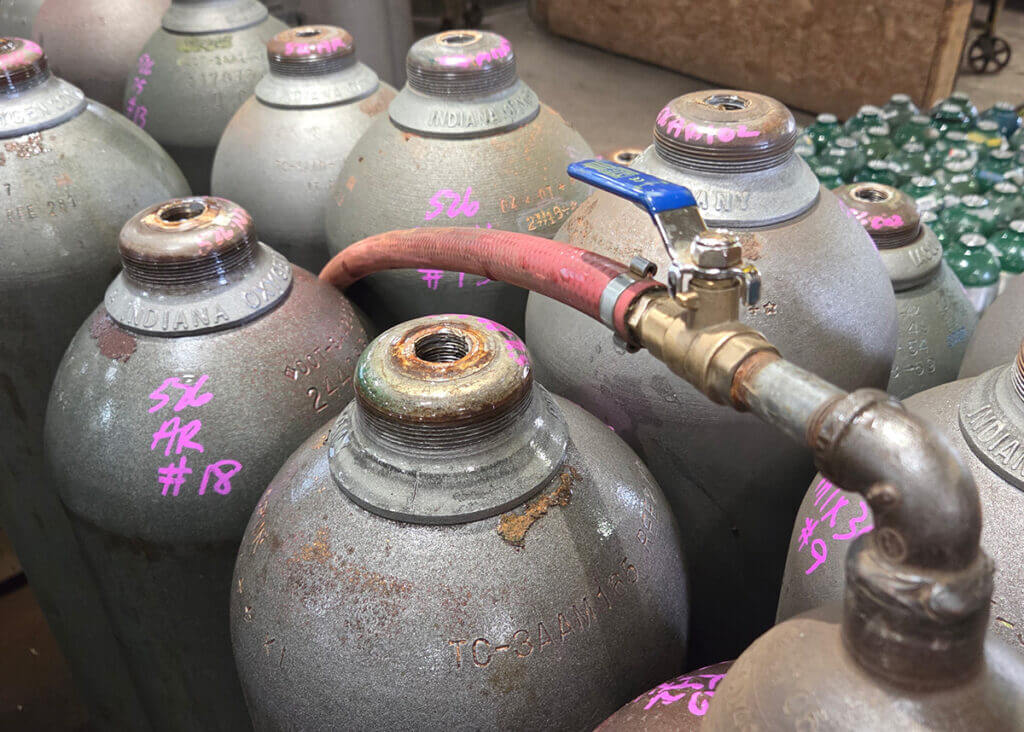
Testing includes four hydrostatic testing stations and two UE testing stations with the capability of testing all sizes of medical and industrial cylinders. All testing procedures follow D.O.T. CFR-49.
The Hydrotest Process
Testing Procedure
- Enter the following information into the computer system:
- Cylinder serial number
- Manufacture date
- Manufacturer name
- Identify the DOT specification stamped on the cylinder to determine:
- The test pressure of the cylinder
- The gas service will determine whether the cylinder allows 10% overfill
- Whether it qualifies for a 5-year or 10-year requalification interval
- Check the cylinder for a stamped REE (Rejection Elastic Expansion) number:
- If the REE number is present, use that value during the expansion calculation
- If the REE number is not present, default to using the C-5 standard value
- Pass or Fail Criteria
- The cylinder must maintain the test pressure for a minimum of 30 seconds without dropping
- The permanent expansion of the cylinder must not exceed 10% of the total expansion measured
- Failure to meet either condition results in a failed hydrostatic test
The Ultrasonic Examination
- Testing Procedure
- Enter the following information into the machine:
- Cylinder serial number
- Manufacture date
- Manufacture name
- Gas Hazmat code & type
- Identify the DOT or ISO specification
- Whether the cylinder allows 10% overfill
- Whether it qualifies for a 5-year or 10-year requalification interval
- Determine dimensions of cylinders
- Make adjustments to code for differences in length
- Calibrate before beginning a set of 10 cylinders
- Begin test
- Pass or Fail Criteria
- Wall thickness less than T min
- No internal/external defects
- Failure to meet either condition results in a failed test
- Calibrate at end of a set of 10 cylinders
-
- If calibration fails all cylinders in set must be re-tested
-
Low Pressure Testing
- We offer a five-year visual inspection for most low-pressure cylinders, combined with blasting and painting services.
- This includes a full range of LP cylinders, from 20 lb grill tanks and 33 lb forklift cylinders to 500 lb “pig” tanks
- Restored to meet safety standards and maintain a clean, professional appearance.
Aluminum Testing & Refurbishment
- The process begins with plastic media blasting to effectively remove existing paint and clear coat, followed by a series of steps designed to restore the cylinder’s original surface finish.
- This is completed with the application of shoulder paint, a heat-sensitive coating, and a protective clear coat, resulting in a durable, like-new appearance that meets both functional and aesthetic standards.
Acetylene Testing
- The process begins with pre-inspection. The acetylene cylinders are first examined for visible defects, and any residual gases are removed using the atmospheric venting system. Once that is complete all cylinders enter into the shot blasting phase, the cylinders undergo wisper testing, valve threads are protected, and then cylinders are shot blasted to remove paint, dirt, and contaminants.
- Once shot blasting is complete a full shell requalification and examination take place. Cylinders are inspected per CGA C-13, including inspection on valves, spud threads, tare weight changes, foot/head rings, porous mass integrity (fire damage, clearance, felt/screens), fuse plugs, and valves—replacing components as needed; cylinders that pass are marked accordingly and painted per customer specifications.